
Heart Watch
Tag4u: fjaa182959 < fjaatbd < fjaawip < fjaastub

Summary
Home Page: https://fjaa4u.org/myheart
Heart watch describes the tracking and possible recovery of a significant portion of my heart’s rate control capabilities which is derived from the intrinsic heart conduction system. This document set is being generated as a fun way to illustrate a variety of technical techniques and concepts by illustrating the monitoring and refinement of a very common physical object that is of great importance to every person alive today. As this post thread is started it is unknown if my heart will ever recover its pacing ability. What is already a certainty though is that a variety of interesting devices, and very capable people with the skills to use those devices, are working hard with me to bring back as much as possible and to have as high of a quality of life along the way as possible.
Quick personal note: You needn’t worry about me. Even if the pacing ability does not recover at all, my current state is a very workable situation. Day to day activities are going just fine. Where I experience the greatest impact is when trying to do physically demanding things like taking a long walk. Currently I just move slower and don’t go as far. Between my car, my ebike, and my wonderfully patient family and friends that still makes for a very full life. So please, no worrying! Just enjoy the journey with me. I must confess that my curiosity is seriously piqued at this time and I am anxious to start refining my homemade heart stress tester so I can really put my heart’s control system through its paces. (Wait, what did he just say? A homemade heart stress tester?? Is he nuts??? This I’ve gotta see…)
Journal
Up / Notes / Next / All (Under Construction)
251118: Upcoming CardioMEMS (more) insertion.
My SOB is related to my congestive heart failure (CHF) (more). Since the CHF continues to worsen, it has been decided to have a CardioMEMS device installed in me. This will help with quantifying my status by monitoring pressure and flow in one of my pulmonary arteries. I have pulmonary hypertension (more) so pressure information will give better guidance to the team on how to adjust my medication(s) and/or other treatments. That procedure is coming up soon. More notes after that procedure! See this article (more) for a nice overview of the situation. (Keyword: pulmhyper)
B4251118:
Miscellaneous topics: Since the initial content, my rate issue was resolved. It turned out that the signal amplitude dropped as a consequence of the ablation procedure and the pacemaker was not seeing the signal. Once the threshold was lowered the heart rate returned. Alas my device was also picking up more lead noise so it is a bit of a rock and a hard place at the moment. However fundamentally I am in a very functional state and view the rate issue as secondary at the moment.
My coronary arteries continue to decrease in flow area over time. On October 15 of this year another angiogram was performed. No new stents but a balloon angioplasty was performed in two of my vessels. The improvement in chest pain reduction has been impressive. I am really enjoying the increased activity levels possible without significant chest pain. Still have SOB.
Initial Content: Background gives the story up to here. The Problem explains the initial challenge; loss of intrinsic triggering of my heart. See the outline (All) for additional sections that have been added.
Initial Note: The content below is very incomplete. I have gone ahead and posted this anyway so that there is a simple, central way, to show participants items in progress. In that way they can follow along with the evolution of this story as it unfolds. Things are very much occurring on a near daily basis currently (250603) so change can come at anytime. As the weeks pass the material that is left behind will presumably provide a brief, cogent presentation of my search for restoration of my heart’s intrinsic pacing ability. For now it may be a bit of a wild ride.
Feel free to hop aboard and explore with us. Just always remember that for the foreseeable future this post is more the journal of an advance scouting team than the polished presentation of the seasoned adventurer back from their quest.
Background
I have been dealing with heart issues since my early 50s. Over 20 years now. First it was coronary artery disease (CAD). I got my first stent when I was 51 or 52 as I recall. I still have it. Call me sentimental.
I got to experience my first (and so far ONLY) heart attack a few years later. The coronary arteries have continued to clog up off and on over the years. Thus I have had numerous heart catheterizations, angioplasties, and stent installations. I’ve had them enough times that I can practically do them in my sleep (oh wait, I always do. Gotta love that conscious sedation).
From arteries I moved on to valve issues. A little leakage here and there turned into a larger amount in my aorta. You can’t begin to imagine how excited the cardiolgist was when my aorta finally flunked the leakage test. Now it was time for open-heart surgery and a valve replacement. He was practically giddy. What the heck, the team decided. Since we will have your chest open we might as well do a few coronary artery bypass grafts (CABGs) too.
All of the above went fine. As each problem was identified over the years, they found a way to fix it. Up to the point of the open heart surgery I had viewed these wonderful people simply as my heart’s medical team. What I was about to learn however is that actually there are 2 major teams that I was soon going to need. Technically I think they refer to themselves as cardiologists and electrophysiologists (EP). I, however, think of them as “the plumbers” and “the electricians” for reasons that became very clear shortly after my valve replacement. My sincerest apologies to anyone who has been helping me if you feel hurt by the the above generalization/simplification. No disrespect is implied as to your capabilities. It just makes it so much easier when explaining heart things to my healthier friends who are simply curious if I will be at the coffee table next week.
My EP chapter began within a week of the valve replacement. My heart just started beating at a low, slow steady rate regardless of what I was doing. It was a miracle! With the new valve, I was 30 again. Yippee!
Wrong. Actually I had a third degree heart block (more). Ignoring all the details what that meant was that my heart’s ability to adjust its rate based on my body’s need for blood had been completely interrupted. Happily in a case like that the heart itself has a failsafe mode where it at least keeps beating at a slow rate. I never passed out. Just had very little endurance to do anything physical.
Jumping ahead several days the net result was that I now had a lovely new pacemaker installed in my chest and my heart was being completely driven by this battery powered electro-mechanical device. I suppose you can think of it as like the starter setup on a car except you keep firing the starter; roughly once every second. Since the heart had retained its ability to decide what was a good rate to beat it returned to setting the heart’s rate. It was simply now 100% dependent on a separate device to put enough power into my heart to trigger each beat, at the time specified by my biological heart.
The Problem
Which brings us to today and my current problem. Over the years my plumbing issues have continued to evolve and the plumbers have kept finding and implementing fixes. Now however there was a new set of occasional issues and the electricians were called onto the field. Even with the pacemaker to power the heart’s trigger, the part of the biological heart that was deciding how fast to beat began to show some issues. Specifically it either got to be too small of a signal and the pacemaker was not receiving instructions, or it would propose a rate that was too fast. Lo and behold I then got to learn about the lower rate limit (more), and the upper rate limit (more). As each issue cropped up some combination of non-invasive and invasive adjustments have been applied.
Alas, with the most recent adjustment (250527) my 20 plus years of successfully dodging unintended side effects finally ran out. Whereas the most recent procedure, an ablation, corrected a problem with the heart requesting excessively fast rates (Afib/Aflutter) the procedure also accidentally completely eliminated my heart’s ability to send a trigger signal to my pacemaker. Fundamentally, the heart is no longer doing the core job of defining and commanding the rate with which my pacemaker should cause my heart to beat. Were it not for my pacemaker and its internal logic to deal with situations like this my heart rate would have dropped back to its minimum rate like right after my heart valve replacement.
Happily it is not yet clear whether the damage is temporary or permanent. In a flash of inspiration it also dawned on my that I have a way to actually manipulate elements of my heart’s hybrid control system and track my heart’s response. By using our family’s exercycle in a specific manner it should be possible to push my body at anytime to make either my heart’s intrinsic pacemaker or my electromechanical pacemaker manipulate my heart’s rate. By tracking the rate using my iWatch and the Fitness app I can see, in a quantitative manner, just which item is adjusting the rate and in what manner. In my first test the intrinsic system did nothing but the EM pacemaker definitely did. Now I can manipulate medications per my team’s instructions and/or how I move and see what effects it has and how things change over time. If I am lucky, in the future the intrinsic pacemaker will start making rate adjustments that are viable and ideally ultimately be back online full time, just like before.
So that is the issue. How to encourage healing and how to track my progress. Read The Target next to learn about how I am going about this.
The Target
Up / Notes / Next / Down / All
Details: Heart Rate Tracking (Top)
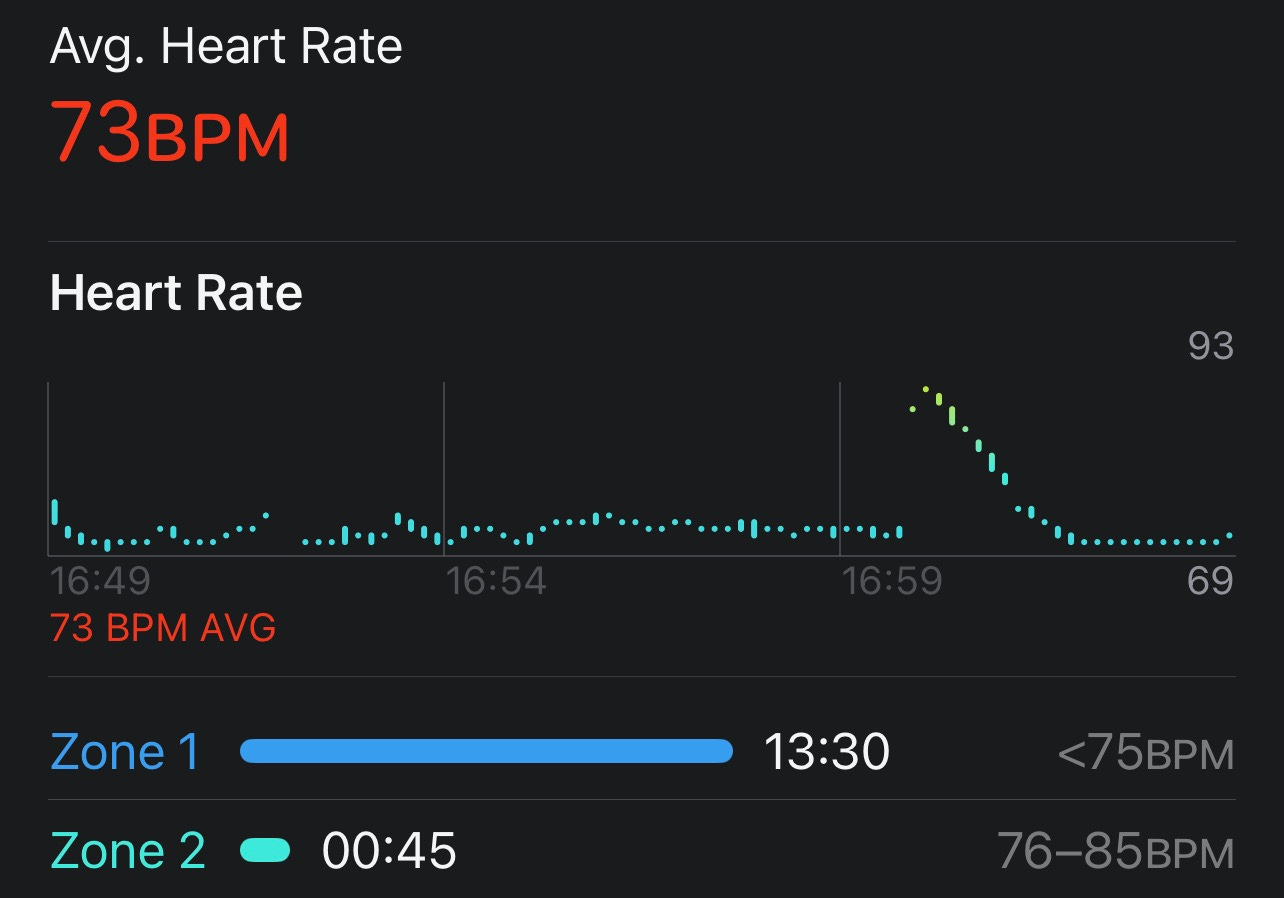
This figure has the information I wish to monitor as I seek to track and possibly even encourage the return of my heart’s pacing ability over time. It is my do-it-yourself heart pacer stress test report that I can generate anytime at our home. The figure will evolve as I learn more about how to stress my heart and what to watch for in the signal. As you look at the plot, in the first third I am sitting quietly on the exercycle. That establishes my base heart rate for the test. In the middle third I am pedaling at some rate and resistance level. In the final third I again don’t pedal. After a short pause I do some motion and then return to my quiet position. The heart rate response I see will hopefully help me learn how best to “control” the device’s rate response to activity algorithm so I can make the most of my activities.
Read on to learn more and play with the ideas and methods.
Figure Summary
This provides a brief summary of each of the primary heart rate figures in this document. To find the specific figure, highlight the fjaa number at the beginning of the line of interest and then search for that text in the body of this document (Help).
fjaa150051: Outdoor walk 250728a. Rate was 80 spm / 70 spm. Working on a higher rate (80 spm). (Notes)
Benchmark Profile
Heart Rate Chart
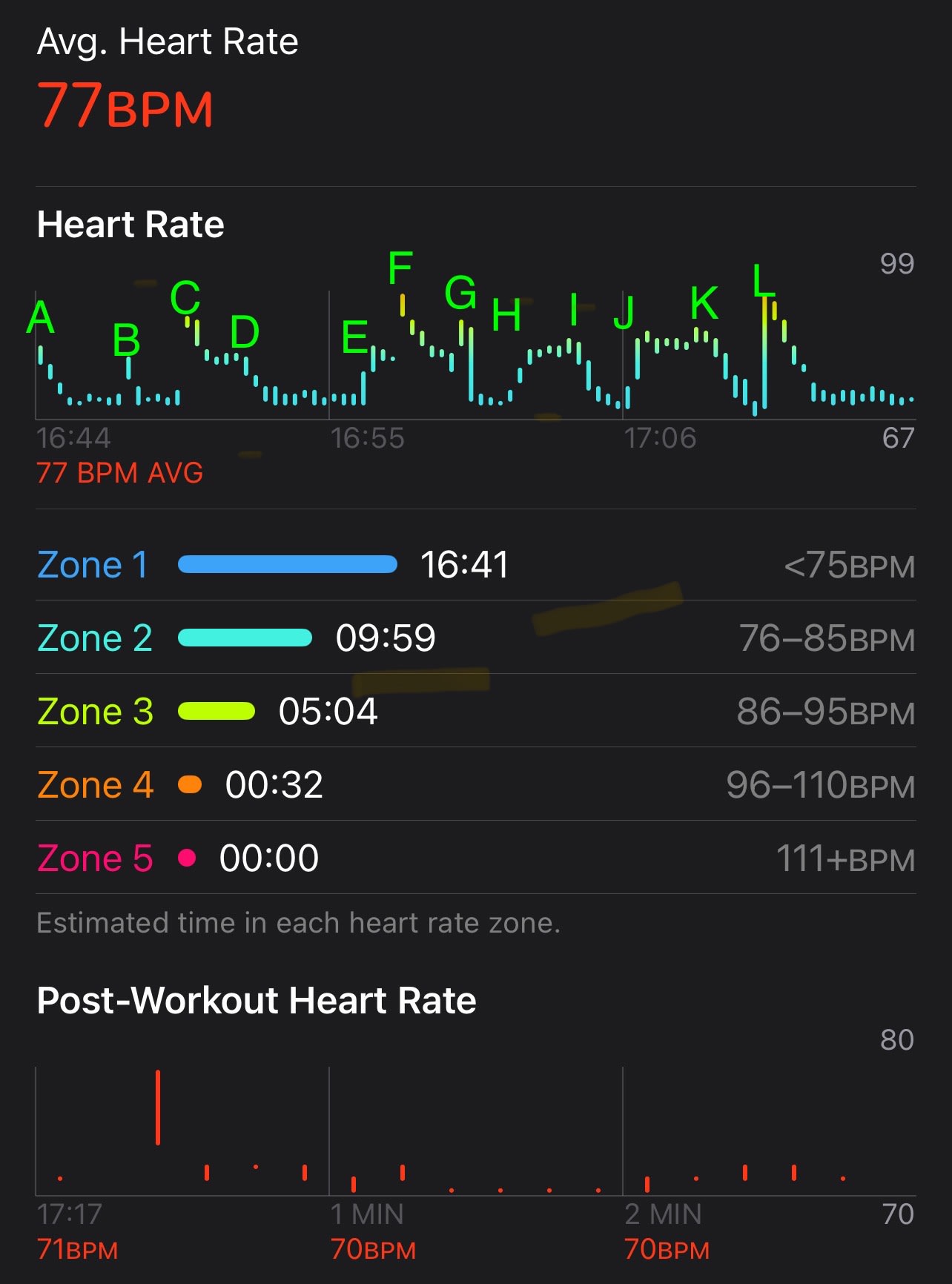
This figure shows a typical heart rate profile for an outdoor walk. Some details about the figure follow it here in the main document. Refer to the Notes for more current and/or dynamic information.
Segment ABC
Initial rest on the bench. The large transient at the beginning of this segement is my heart rate slowing from the level it was at while walking around the yard. The blip at B is confusing to me as I was still sitting on the bench. C is the point where I did my triple bob and then stood up to start my walk. The metronome was set at 80 (i.e. 80 spm). So far this week my previous walks had included rates of 60, 65, and 70 spm. For previous walks I started at a slow rate and then experimented with walking faster. This time I wanted to start out fast and then see how things improved as I reduced the rate when chest pain became and issue.
Segment CDEF
From C to D is my heart rate slowing after the bobs. The plateau just before D is nominally the heart rate I experience regardless of walking pace. The droop between D and E was a time where I had stopped but remained standing in order to take a phone call (Tricia from the Device Clinic). I resumed walking at E and did a quick sit and triple bob at F, when I had reached the bench that was my goal for this walk. I sat only long enough to do the triple bob and then continued my walk.
Segment FGH
Like from C to D, between G and H my heart rate declined from the artificial high of the triple bob to my nominal rate when walking. At G I had sufficient shortness of breath and/or chest pain that I chose to stop, remaining standing, and wait for a couple of minutes. Between G and H is the profile as the heart rate dropped, pain and shortness of breath cleared. In the latter part of that region (i.e. just before H) the heart rate rises as I resumed my walk.
Segment HIJ
Resumed walking at H. By I the chest pain was enough to stop again. This time I also lowered the metronome rate to 70 (i.e. now 70 spm). Resumed walking at J.
Segment JKL
Arrived at the bench in the back yard, where I had started. Stood at the bench while my heart rate slowed. Wanted to see how that heart rate decay would compare to the next one after the triple bob. At L I did my triple bob.
Segment LtoEnd
Did my triple bob at L, then sat down on the bench and rested quietly for about 5 minutes before ending the workout on the watch.
Path Walked
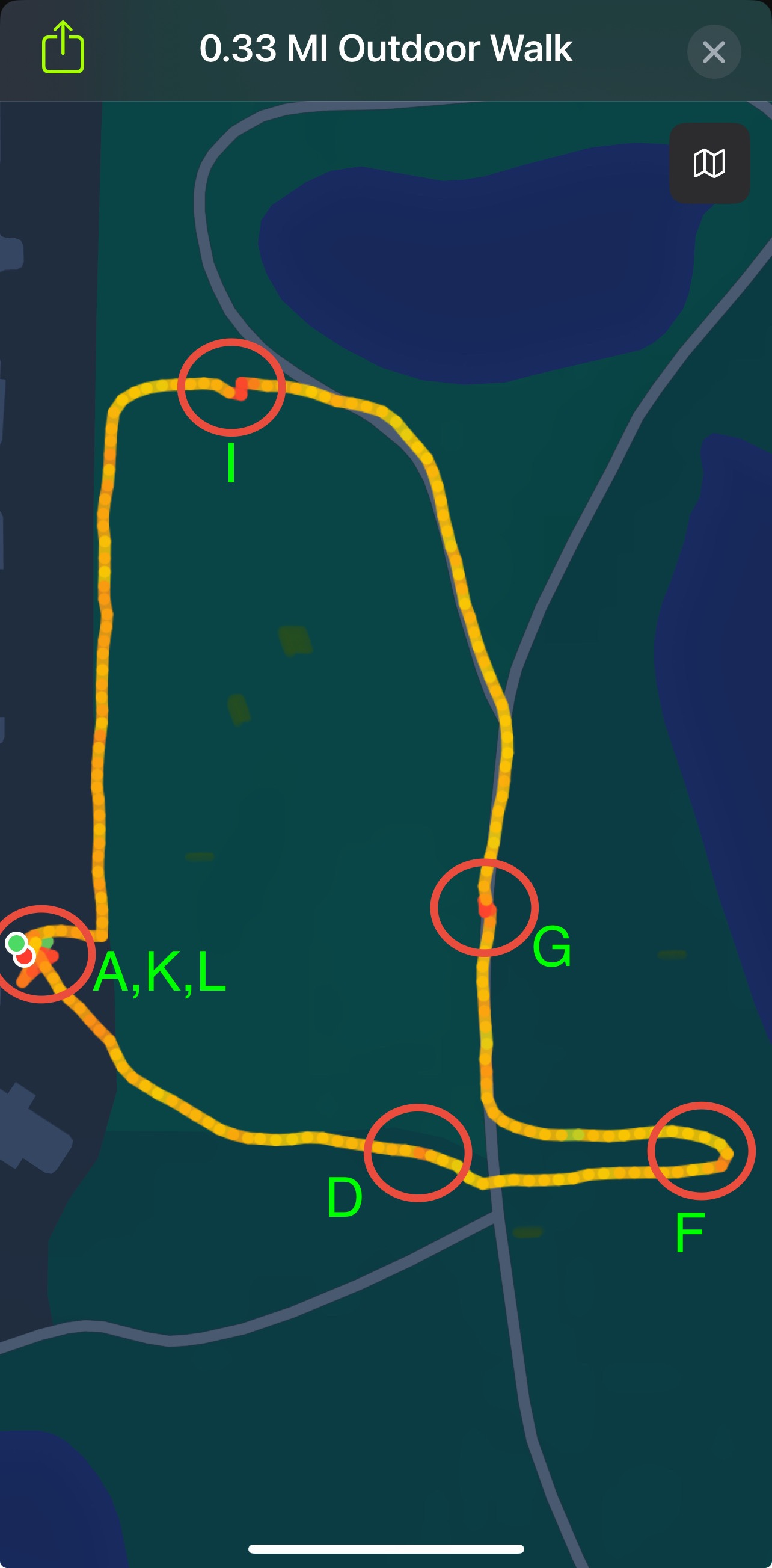
This figure shows the path walked during the test. Of note are the circled points. Those letters correspond to the letters in the heart rate figure above (fjaa150051). In my raw notes from the walk I also have videos at those locations explaining how I was feeling.
Background-Ablation
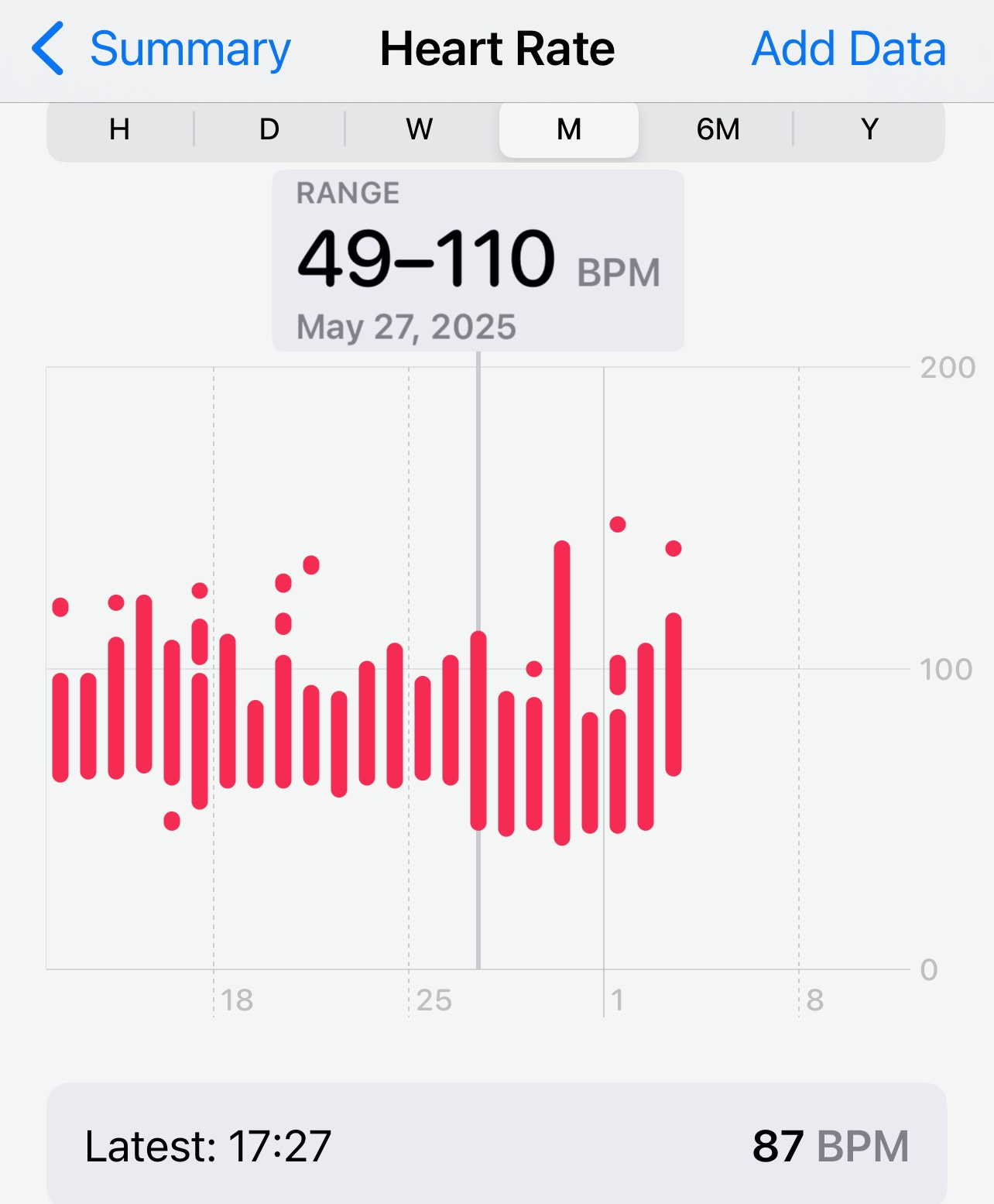
On Tuesday May 27th, 2025 the heart pacing ability of my heart was disrupted as a side effect of a corrective heart procedure. Happily I already had a mechanical pacemaker (aka my device) so rather than my heart dropping to a throughly miserable (but survivable) 35 bpm my pacemaker kicked in and kept me at a much safer (but still long term inadequate) 50 bpm. The figure below shows the distribution of my heart rate over a 1 month period.
These are the heart rates for the last month. May 27th is where the ablation (the cardiac procedure) tanked my heart rate (the drop down). The step up yesterday (June 2) is where the device nurse changed a pacemaker setting to give me a higher minimum heart rate (i.e. back to 70 bpm). Today I met with the electro-physiology (EP) physician’s assistant (PA) who told me there is good reason to be optimistic. The procedure that was done can just irritate portions of the heart that are involved in setting the heart rate, impeding its ability to do its job. Over time that clears up and the pacing function returns. At least that is the theory!
Profile Examples


Stress Test Summaries
Outdoor Walk Tests
Aug 4, 2025: Outdoor Walk (60spm-70spm)


I did this short walk today to see if I could come to a stable heart rate level walking. This is a similar kind of thing to what I did two days ago for the extra cycle. I started out at a quite slow rate of 60 SPM. Then when I got to a spot where I was short of breath, a chest pain I stopped and I set the rate up to 70spm to see if it would remain stable at that rate as well. As you can see on the result at 70 it was starting to increase towards the end. Not conclusive at least I know I can come up with something flatter than To Do as I had on my first walk.
August 2, 2025: Outdoor walk (70spm)


First outdoor walk in my stress test mode since the adjustment to my pacemaker sensitivity for atrial sensing. As you can see, there’s a tremendous difference in the heart rate behavior. Also, there are two other screenshots. One shows my segments and the other shows the map. The route is pretty similar to what I’ve done on other days. You’ll see by the little dog legs, each place where I stopped. I had one less stop on this walk today.
I did have shortness of breath that caused me to stop. Also, that chest pain seems to be focused in the two spots on my chest; one on the side of the sternum. All, although this was a delightful improvement over previous days.
Indoor Cycle Tests
Aug 2, 2025: Indoor cycle (45rpm)


I did this short ride at a slow rate looking for my heart rate to stay wise at the level during the ride. What I got is unusual plot that you see. Specifically it does come up gradually and then starts to plateau somewhere around 90 to 95. Then the unusual step two I believe it was 103 where it stayed stuck there for a while, then gradually worked its way down. Then a decade back to 95 each per minute after I stopped. I find that rate very unusual. Also, I don’t understand why that jumped up and got stuck at the high rate.
In case, the lower cycling grade did at least cause it to not stabilize. It just seems slower than I thought I was doing previously.
Aug 2, 2025: Indoor cycle (53rpm)


For this cycling, I tried to keep the cyclic rate at about 53 RPM. More specifically it would usually range from 52 to 54 RPM. The resistance level with level one.
There is also a screenshot of the segment times. It’s not clear with the indoor cycle what importance that is. Is he collect though so I will probably keep doing it.
Publications
Help
Various items in this document will have help notes associated with them. Follow the (Help) link provided there to get more information. A large percentage of help material will simply be comments attached to this document. Only the items of large, recurring interest will receive greater attention and content.
Methods
Reporting
When I am examining some element of my heart’s behavior, the process is very often
Start iWatch Workout
Do something
Take screenshot of workout highlight
Add notes in Photos to the screenshot
Add a gallery of images to Heart Rate Tracking
Add comments for the gallery to Heart Rate Tracking
Report in to Heart Clinic.
Outline
In the future this section will include a hierarchical list of section names and links.
Publications Section
********
========
Up: https://albrightj.substack.com/i/165142801/publications
Help
********
========
Top: https://albrightj.substack.com/i/165142801/help